Tonight a small but enterprising Miami-based TV network, SoiTV, will air a revealing interview with former Venezuelan Supreme Court Justice Eladio Aponte Aponte, who has been under the protection of the U.S. DEA for several days. The authors of this article had access to the interview results.
Judge Aponte Aponte is, so far, the highest official who has defected since Hugo Chávez came to power. His testimony presents a unique view into the criminal structure promoted by the current Venezuelan government. Aponte also names individuals who have committed serious violations of Venezuelan human rights and attacks on foreign interests.
Mr. Aponte confessed that he received direct orders from President Hugo Chávez to use his legal power against individuals that opposed the regime. As president of the criminal tribunal of the Supreme Court, Aponte had supervision of all criminal courts in the country and practically on all judges, with a capacity to influence almost any judicial decision.
Moreover, in his testimony Mr. Aponte says he also received calls from Gen. Henry Rangel Silva, Venezuela's Defense Minister and Hugo Carvajal, who until recently was the head of military intelligence, among others, ordering him to "manipulate judicial proceedings." Both Rangel Silva and Carvajal have been designated by the U.S. Treasury as "drug kingpins" for their ties to the narco-terrorist FARC guerrilla army in Colombia. Moreover, Aponte alleges that he has "evidence" of the high officials' ties to narcotics traffickers. An example he cites is that of a drug shipment that was safeguarded overnight in a Venezuelan military base. Aponte says he was ordered to provide legal cover for the drug shipment as it made its way from the border to "the center of the country" (on the coast, where Venezuela's ports are located).
Aponte also admits to having been linked to other important figures designated by the U.S. Department of Treasury as international drug traffickers, such as Walid Makled who, according to a federal indictment in New York, sent hundreds of tons of cocaine into the U.S. with the help of top-ranking Venezuelan officials. Makled's "trial" began a few days ago in Venezuela.
It was, in fact, Aponte's link to Makled that led to Aponte's removal from the Supreme Court by the General Assembly of Venezuela and his subsequent defection to Costa Rica, where the DEA picked Aponte up. Makled had been arrested in Colombia nearly two years ago and extradited to Venezuela in 2011. While in a Colombian prison, Makled was interviewed by various U.S. law enforcement agencies, and his testimony implicated Aponte in drug trafficking. Since Chávez has had Makled in his jails for nearly a year, Chávez knew what Makled was going to say at his trial about Aponte, and therefore Aponte had to be "sacrificed" to save Chávez and what the Venezuelan people call his "narco-generals."
Numerous reports from the U.S. State Department and international human rights monitors indicate that the Venezuelan judicial system is used by the President Chávez as a tool to punish and persecute opposition leaders, as well as to obtain the release of drug traffickers.
Aponte's testimony is probably the most important evidence so far to show the lack of independent institutions in Venezuela, the existence of political prisoners, and the links between high-ranking members of the Venezuelan government to drug trafficking and criminal organizations such as Colombia's FARC.
Otto J. Reich is president of the consulting firm Otto Reich & Associates LLC. He is a former U.S. assistant secretary of state for the Western Hemisphere, and U.S. ambassador to Venezuela. Follow him on Twitter: @ottoreich
Of course, Hugo & his minions claim that all of the above is just another Yankee conspiracy
Friday, April 20, 2012

Friday, April 6, 2012
Hasta Cuando?
 from The Telegraph
 Venezuelan President Hugo Chavez wept and asked God to spare his life during a pre-Easter Mass on Thursday after returning from his latest session of cancer treatment in Cuba.
Very little is known about the 57-year-old socialist leader's condition, including even what type of cancer he has. Chavez has undergone three operations in less than a year, and received two sessions of radiation treatment.
He says the latest surgery was successful, that he is recovering well and will be fit to win a new six-year term at an election in October. Yet big questions remain about his future, and on Thursday the strain appeared to show.
In a televised speech to the Catholic service in his home state of Barinas, Chavez cried and his voice broke as he eulogised Jesus, revolutionary fighter Ernesto "Che" Guevara and South American independence hero Simon Bolivar.
"Never forget that we are the children of giants ... I could not avoid some tears," the former soldier said, his parents and other relatives looking on from the church rows.
"Give me your crown, Jesus. Give me your cross, your thorns so that I may bleed. But give me life, because I have more to do for this country and these people. Do not take me yet," Chavez added, standing below an image of Jesus with the Crucifix.
Flying back and forth to Havana for the radiation therapy, Chavez has been forced to run a kind of "virtual" campaign via Twitter and appearances on state television, while his opposition rival Henrique Capriles tours the country.
In his speech at the Mass, Chavez soon seemed to recover his composure, joking with his brother Adan in the congregation that few people were watching because it was the Easter holiday, when Venezuelans typically hit the country's beautiful beaches.
Chavez said he had a lot of faith that his cancer would not return after his first two operations last year – which removed a baseball sized tumour from his pelvis – but it did.
"Today, I have more faith than yesterday," he said.
"Life has been a hurricane ... but a couple of years ago my life began to become not my own anymore," the president said. "Who said the path of revolution would be easy?"
He returned to Barinas late on Wednesday from Havana, where he had undergone a second session of radiation therapy. He said it went well and that all the test results had been positive.
But in the absence of detailed information on his condition, Venezuelans have hunted for clues in his appearance each time he is on state TV. One local news website ran a large photo of his heavily perspiring brow after he disembarked from the jet.
One Venezuelan opposition journalist who has broken news on Chavez's condition in the past reported that his medical team continued to disagree among themselves over the best course, and a Brazilian blogger said he might travel there for treatment.
Chavez's election rival, Capriles, has mostly kept quiet about the president's illness, preferring to wish him a speedy recovery so that he can beat him in a fair fight at the polls.
But the youthful state government has criticised Chavez for choosing to be treated abroad, saying it sends a bad message to ordinary Venezuelans if he does not trust local doctors.
Capriles, 39, took issue this week with repeated comments by Chavez and his allies that Jesus must have been a fellow leftist radical.
"This theme is an obsession of the eternal candidate," Capriles said on Twitter, referring to Chavez. "This Holy Week, we should remember Christ was neither socialist nor capitalist."
In the latest opinion poll released last month, the president had a solid 13-percentage point lead over his opponent, but many voters remained undecided.
Friday, March 30, 2012
Saturday, March 17, 2012
Sunday, March 4, 2012
Mural in the "La Piedrita" Collective, 23 de Enero Barrio, Caracas
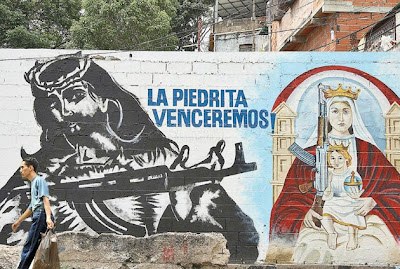 ...and that's not all.
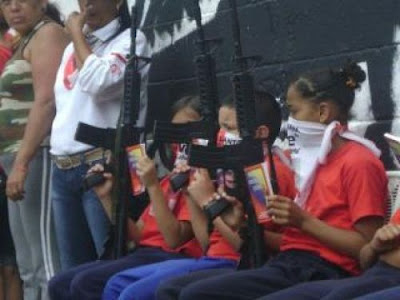
 CARACAS, Feb 3, 2012 (IPS) - A radical political group based in a working class neighbourhood of the Venezuelan capital has sparked a furore by publishing photographs of children from the community, with their faces partially hidden, brandishing AR-15 assault rifles.
The group in question, the La Piedrita Collective, controls the 23 de Enero parish in Caracas, a neighbourhood that has been a leftwing stronghold for decades and is where President Hugo Chávez - whom the collective claims to support - casts his vote during elections.
Photographs posted on internet social networks Jan. 29 show youngsters participating in a public event, alongside adult men and women, wielding assault rifles in front of murals of famous guerrilla fighters, as well as one depicting Jesus Christ armed with a similar weapon.
On numerous occasions in recent years, the La Piedrita Collective has released pictures of its members, sometimes masked, openly carrying guns in public. It has also claimed responsibility for tear gas grenade attacks on the headquarters of media outlets, the Catholic Archbishopric, the Caracas Athenaeum and the Christian-Democratic opposition party COPEI.
There is an outstanding warrant for the arrest of the group’s top leader Valentín Santana, accused of homicide, and Chávez himself ordered Santana’s arrest during a 2009 television programme.
But the order has never been carried out, and Santana is reported to have been in attendance at a public event held in the parish this January by the ruling United Socialist Party of Venezuela (PSUV).
Minister of Interior and Justice Tarek El Aissami stated that the government "rejects and condemns the handling of guns by children and adolescents," something it considers unacceptable because it "violates the moral principles established in the constitution and threatens the integral development of our children."
El Aissami ordered an investigation to determine who is responsible for the pictures of the armed children, some of whom appear to be as young as five years old.
The Public Prosecutor’s Office has also instructed the Department of Family Protection to open an investigation "to determine both the veracity of the events and the individuals responsible, and to take action accordingly."
Pablo Fernández, technical secretary of the recently created Presidential Commission for Firearms Control and Disarmament, said that what was most troubling about this incident was the "grotesque, irresponsible and immoral" way in which children were used.
He stressed the need to establish the responsibility of the adults who organised the event at which the photographs were taken, as well as those who took the photographs, whatever their intentions, because "children as young as these have little understanding of how they are being used."
Fernando Pereira, co-director of CECODAP, a Venezuelan NGO that works for children’s rights, told IPS: "This affair needs to be clearly addressed. What we hear from mothers and fathers on the streets is that they want to see concrete evidence of political will to protect children and adolescents, and that violence must not be condoned."
Pereira added that spreading images of children with guns was like "adding fuel to the fire of the already well-known problem of violence."
In Venezuela, with a population of 29 million, a million and a half crimes and 19,000 homicides are recorded annually, according to CECODAP.
El Aissami, while not specifying the actual number of slayings that year, reported in late 2011 that the murder rate in the country was 48 per 100,000 population.
Every month, around 100 children and adolescents in Venezuela fall victim to violent death, says CECODAP.
Different NGOs offer varying statistics regarding the number of firearms illegally in the possession of the general population, with some claiming the total to be in the millions.
Rocío San Miguel of the Citizens’ Watch for Security, Defence and the Armed Forces told IPS that the AR-15 rifles shown in the photographs, manufactured by ArmaLite of the United States, "have been used by the political police, and its chief, general Miguel Rodríguez, should explain how they came to be in the possession of those who are using them in 23 de Enero." Rodríguez is the head of the Venezuelan intelligence service.
San Miguel stressed that Venezuela is a signatory to international agreements that prohibit the participation of children in armed groups, in addition to national legislation adopted to ensure respect for the rights of children.
Under the Law for the Protection of Children and Adolescents, it is illegal to provide minors under the age of 18 with access in any way to tobacco, alcohol, illicit drugs or pornographic material. There is also a law to protect minors from exposure to war-related toys and videogames, as well as to messages that promote hatred or violence.
"Any adults who endorsed this incident through their presence are directly responsible both morally and criminally. They should have been arrested immediately, because they are completely identifiable," sociologist Luis Cedeño of the NGO Active Peace commented to IPS, adding that the government needs to ensure that these arrests are made in order to clearly distance itself from the incident.
After the scandal erupted, some of the women who appear in the photographs with the armed children released a video filmed in a classroom with the young pupils holding up books on Venezuelan history and the country’s constitution, in which they state, "These are the weapons we give to our children."
The La Piedrita Collective also acts as a "consejo comunal" or community council, a local organisational body created by the government to fund community services. In this capacity, it operates public transport vehicles, a brick factory, sports fields and an ambulance.
In June and July 2011, when heavily armed prisoners rioted for three weeks in a penitentiary near Caracas, congressman Diosdado Cabello and a La Piedrita Collective member who identified himself to the media only by his alias, "Satanás" (Satan), acted as mediators between the prisoners and the government to resolve the conflict.
Cabello, the president of the National Assembly (Congress) since January and vice president of the PSUV, declared on the day after the photographs appeared, "We totally and utterly condemn the use of children in this way.
"The people responsible for this are doing a great disservice to the revolution," he stressed. "The president has tirelessly repeated that this is a peaceful revolution, that it does not use weapons, which are solely used by the armed forces."
Opposition leaders, especially those vying to be chosen as candidates for upcoming presidential and local Caracas elections, have not only loudly condemned the actions of the La Piedrita Collective, but have also accused the government of tolerating, encouraging and even supplying weapons to this kind of group.
Campaigning is already under way for the presidential elections scheduled for Oct. 7. The opposition coalition, Mesa de la Unidad Democrática (MUD), will choose its candidate from among five hopefuls in primary elections to be held Feb. 12.
 The gratitude of the freed/ formerly oppressed.
Subscribe to:
Posts (Atom)